

With ipolog Materialflow the number of resources can be evaluated. This evaluation takes place in the Moudl Evaluation/Submodule Investment Costs.

The calculation is explained using a small example project:

This example contains resources from the Logistics Equipment class and the Means of Transport class.
The logistics equipment includes load carriers, loading units, and racks.
The Means of Transport class contains direct means of transport, tuggers, and trailers.
Logistics equipment
The calculation of all load carriers / load units is based on the warehouse evaluation.
In the example, the load carrier type 4315-KLT is examined. Currently, the part number SNR-111 has assigned this container in three stages.
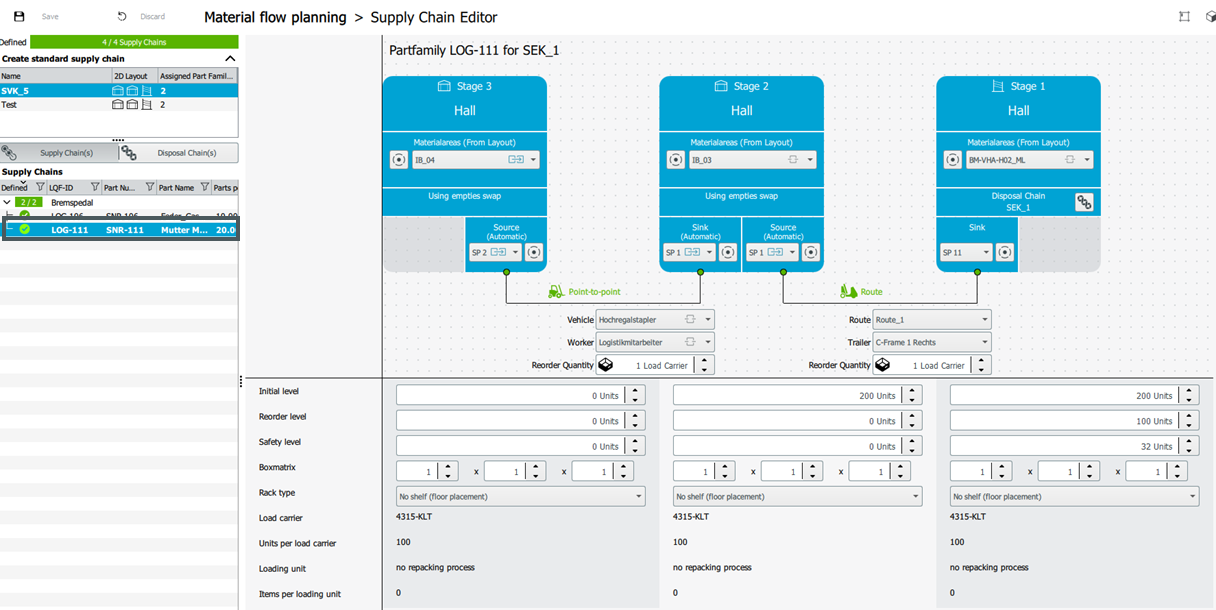
Decisive for the inclusion of the containers in the warehouse evaluation and thus for the investment costs are the replacement quantities between the levels and the reorder level.
The reorder quantity is always counted to the level to which the container is transported. The unit of this is - depending on what is defined in the standard supply chain - the loading unit or load carrier.
The reorder level is arranged under each level in the parameters. The unit is divided into parts. As of Release 2019-04, the reorder point is set automatically on the basis of a calculation. This calculation is based on the parts per load unit/load carrier.
Number of load carriers required based on the parameters set in the supply chain:
- Stage 3: 0 load carriers
- Stage 2:
- 1 Load carrier based on reorder quantity for transport between stages 3 and stage 2
- No further load carriers, as reorder level = 0
- Stage 3:
- 1 Load carrier based on reorder quantity for transport between stages 2 and stage 1
- 1 load carrier based on 100 parts, which fit exactly into one container, for the reorder level.
In this example, 3 load carriers are required for load carrier type 4315-KLT in total.
The number of load carriers required for this load carrier type is now fixed. Now the costs for the load carrier 4315-KLT are still missing. These can be stored for the load carriers in resource management. The decisive factor here is that this attribute is already stored when the load carriers are imported, as it is currently not possible to make subsequent adjustments in the software.
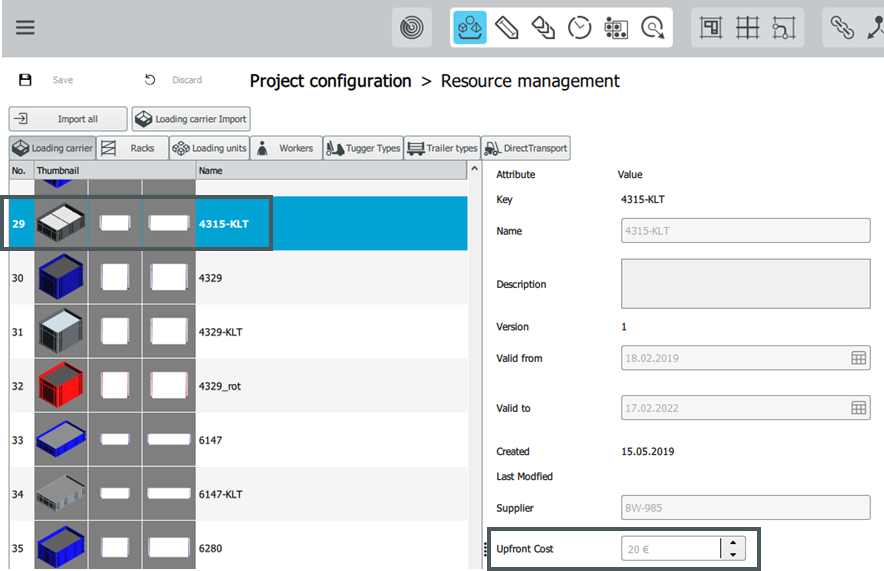
The 4315-KLT load carrier has an upfront cost of 20€.

Thus for the load carrier 4315-KLT investment costs of 60€ are calculated.
The load units are calculated in the same way as the load carriers.
Calculation of load carriers in loading units
However, it must be borne in mind that load units contain load carriers. The number of load carriers per loading unit can be defined in the logistics quantity structure. In addition, the defined reorder level is decisive.
The following example is used for the calculation:
| Container type | loading unit | load carriers |
| container name | 1211-KLT-GB-1040 | 3147-KLT |
| Parts in container | 100 | 10 |
| Number of load carriers per load unit | - | 10 |
| costs | 186€ | 5€ |
Reorder quantity = 1 loading unit
Reorder level = 150 parts
In this case, 3 loading units are required in the cost evaluation. This includes the reorder quantity (1 loading unit) and the reorder level (150 parts = 2 loading units). This results in costs of 558€ for the loading unit.
However, the load carriers contained in a loading unit are still missing.
In this example, 10 load carriers are required for the reorder quantity. For the reorder level, there are 15 containers, since each load carrier contains 10 parts.
This results in additional costs of €125 for 25 load carriers.
Costs for empties
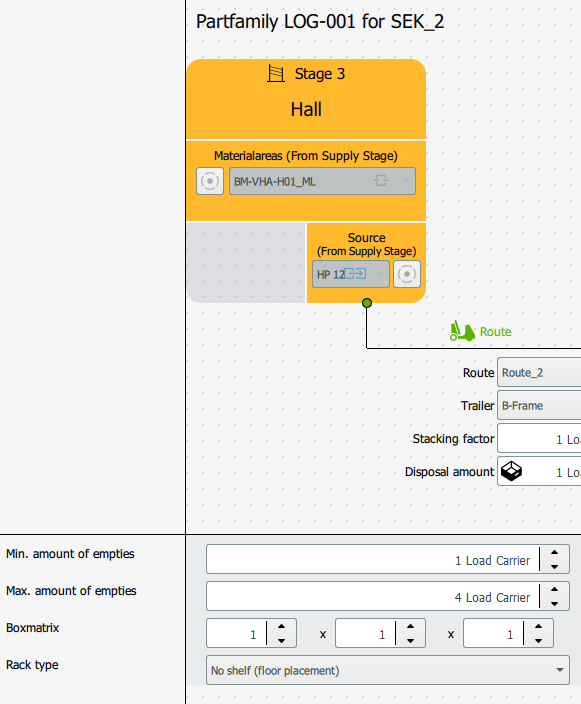
Costs for empties are also taken into account when calculating costs and resources. The maximum amount of empties is the decisive factor for the calculation in addition to the acquisition costs for the containers defined in Resource Management.
The maximum amount of empties is defined in the supply chain editor submodule for the corresponding disposal chains.
If, for example, the maximum amoun of empties is set to 4 load carriers on one level, 4 load carriers are taken into account in the cost evaluation in addition to the full product containers.
Means of Transport
The basis for the means of transport is the evaluation of dynamic transportation planning.
In the example, a maximum of 3 stapler_01 is required, but on average only 0.78 stapler_01.
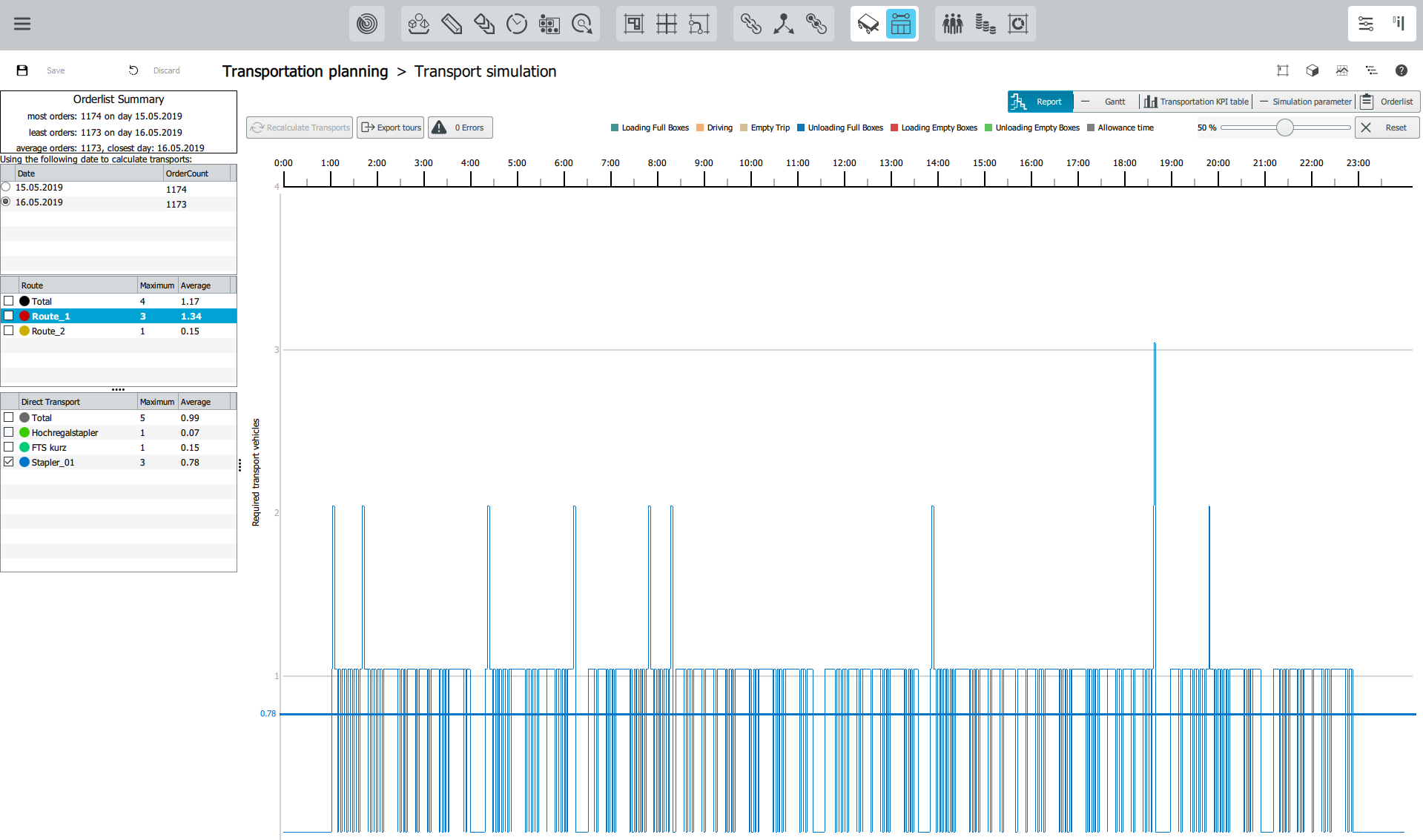
For the investment costs, these two values are taken and offset against the investment costs of the resource.
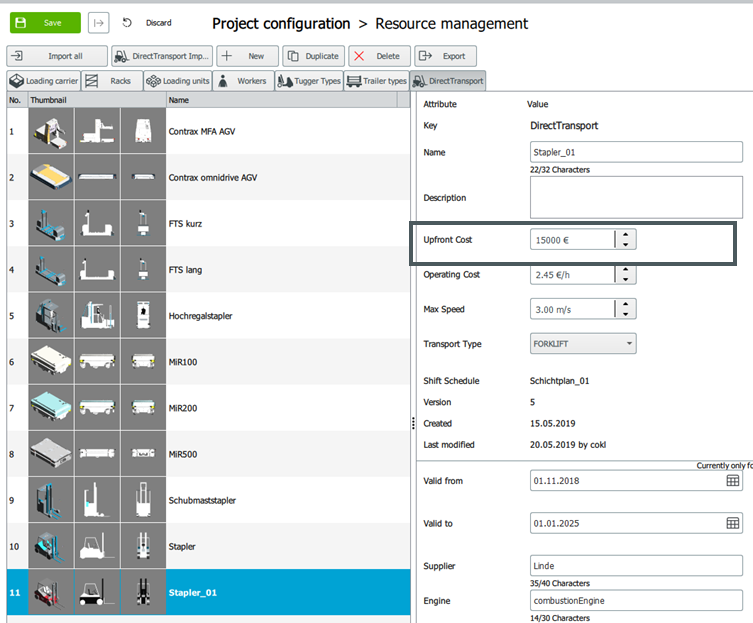
Thus the maximum investment costs of 45.000,00€ and average investment costs of 11.639,54€ result.

The calculation in the group means of transport, e.g. for tuggers, is analogenous to the calculation for direct transports.
Ongoing Costs
The ongoing costs are calculated in IPO.Log on the basis of the hourly costs of the different workers and the results from the submodule manpower.
In the following the calculation of the operating costs is explained exemplarily by the worker "Logistikmitarbeiter".
From the resources, it can be seen that the Logistikmitarbeiter has an hourly cost of 45.50 €/h.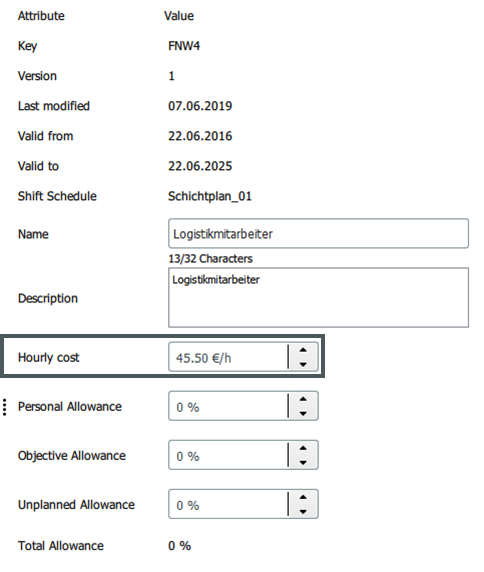
Furthermore, the number of Logistikmitarbeiter required for processes and for the transport of materials can be seen in the personnel requirements. This information is retrieved for each shift. Finally, the net working time of the Logistikmitarbeiter per shift is required. In the example, this is 6.833 h/shift.
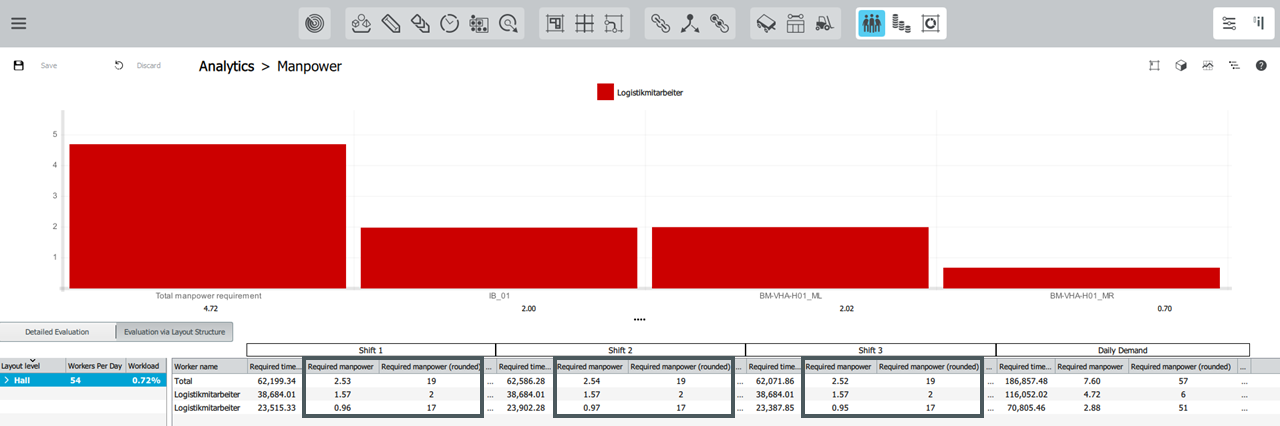
These are the input data for calculating the operating costs for the Logistikmitarbeiter
The operating costs for the Logistikmitarbeiter are now calculated as follows:
- Cost shift 1 = hourly cost x requirement shift 1 x net working time shift 1
- = 45,50 €/h x 2,53 x 6,83 h= 786,24 €
- Cost shift 1 (rounded) = hourly cost x requirement shift 1 (rounded) x net working time shift 1
- = 45,50 €/h x 19 x 6,83 h= 5.904,54 €
- Cost/day = Cost shift 1 + Cost shift 2 + Cost shift 3
- = 786,24 € + 789,34 € + 783,13 € = 2.358,71 €
- Cost/day (rounded) = costs shift 1 (rounded) + costs shift 2 (rounded) + cost shift 3 (rounded)
- 5.904,54 € + 5.904,54 € + 5.904,54 € = 17.713,62 €
Note: The results in IPO.Log can differ slightly from the manually calculated results, because IPO.Log calculates with more than 2 decimal places in the background.
The operating costs in the Cost Evaluation submodule, which are based on manpower requirements, also take the waste disposal chain into account.