

The path length is calculated on the basis of the distance between two defined stopping points.
In further consideration of path length and path selection, a distinction must now be made between transport by route and transport by direct means of transport:
Transport by route
The length of a route is displayed when the route history is defined. It is calculated from the sum of the distances between two breakpoints or waypoints that are approached one after the other. The distances between successive stopping points or waypoints can be taken from the detailed Route Run in the Create Route submodule. 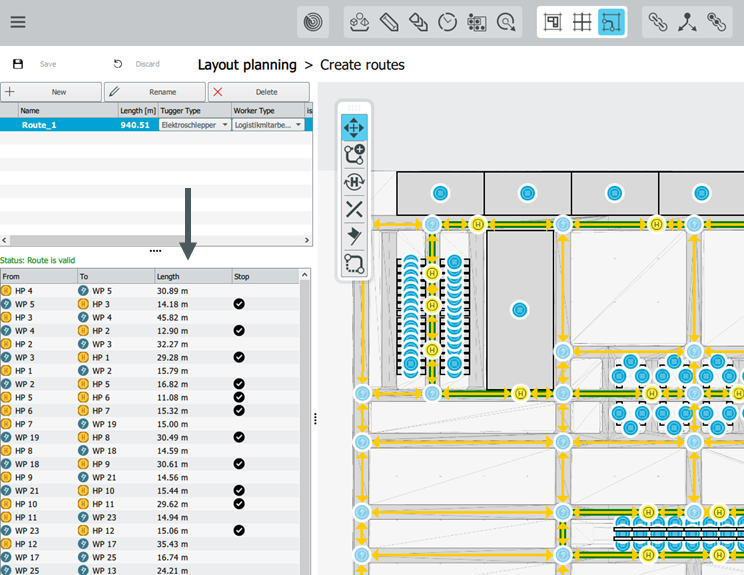
The length of the route is always fixed. The tugger train only runs on the defined route.
When creating routes, the defined restrictions for one-way and two-way traffic as well as forbidden route sections for the selected tugger type are taken into account. These restrictions are defined in the Create Transport Network submodule.
If speed restrictions are defined in the Create Transport Network submodule, they are taken into account when calculating the duration of the transport time. Further information can be found in the article Calculation logic transports - shortest Path / Shortest Transport Time.
Transport by direct means of transport
The path length for direct means of transport is calculated on the basis of the defined path restrictions (create one-way and two-way traffic as well as restrictions or direct means of transport on certain route sections in the Create transport network submodule). When calculating the path length, the stopping point of the source and the stopping point of the sink must first be considered in the Supply Chain Editor submodule. Thus the starting point and the destination for the considered transport are fixed.
The next step is to check the settings in the Transport Simulation/ View Simulation Parameters submodule. Here you can define the calculation logic for the transport. Here you can choose between the shortest route and the shortest transport time.
If the shortest path is selected, the path is selected on the basis of the shortest length of the transport sections between the stopping point of the source and the stopping point of the sink. The pure meters between these two points are decisive. However, the restrictions are still taken into account so that the means of transport only travels on the route section between source and sink that is also permitted for the selected means of transport.
If a means of transport cannot serve the transport request due to transport restrictions, it cannot be found in the supply chain editor in the list of all possible direct means of transport or is taken from the respective field after selection of an area.
When selecting the shortest transport time, the permitted speed on the path sections is taken into account in addition to the path length. The duration for the transport between source and sink is calculated for all possible path sections. From the large number of transport options between source and sink, the path with the shortest transport time is selected.