

The following conditions must be set before the occupied trailer areas can be calculated:
- used trailers have material areas
- one or more leading edge(s) is/are selected for the trailer material areas
The assignment of a material area of a route train trailer is carried out according to the following logic:
A fixed container subset is to be placed on the trailer:
Step one:
The next container subset to be placed is selected using the processing sequence.
Step two:
If two leading edges are selected for the material area of a trailer, the following two cases exist for the placement at the leadingedge, which are treated differently as described below:
either width or length of container > half of the distance between the leading edges
- Applies (case 1): The container is turned and placed (with the longer edge) on the leading edge of the trailer
- Not applicable (case 2): The container is not turned and placed (with the shorter edge) to the leading edge of the trailer
For case 1 the following four conditions are checked one after the other during placement:
- Does the container in the rotated state (longer edge) fit the preferred edge?
- Does the container in the rotated state (longer edge) fit the non-preferred edge?
- Does the container in the non-rotated state (shorter edge) fit the preferred leading edge?
- Does the container in the non-rotated state (shorter edge) fit the non-preferred leading edge?
Example case 1:
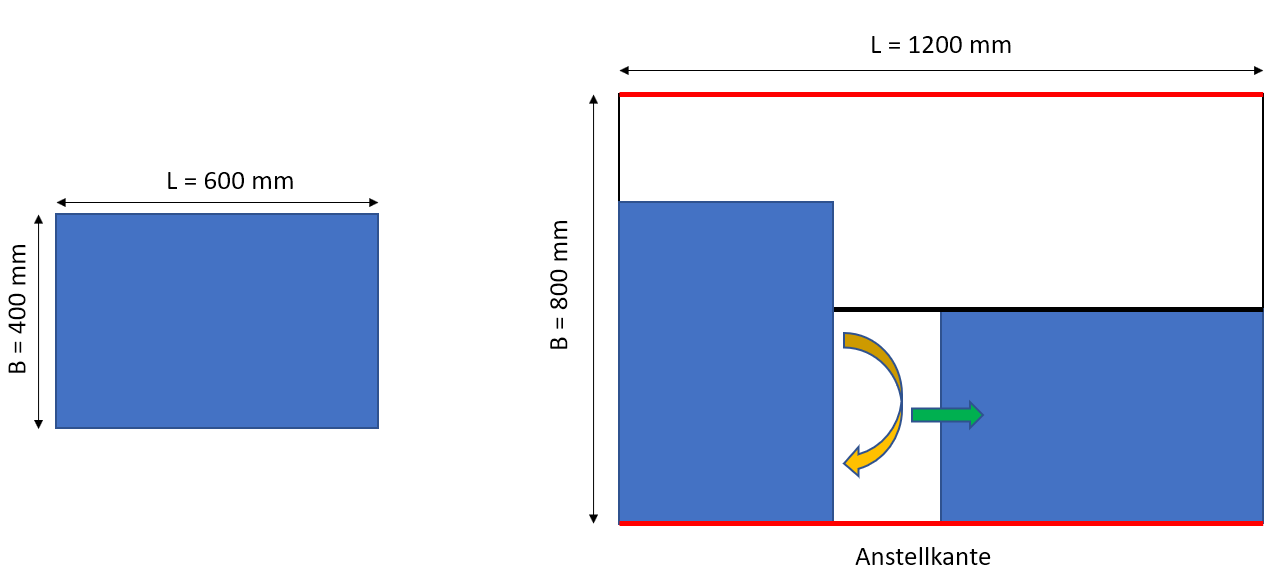
For case 2, the following four conditions are checked one after the other during placement:
- Does the container in the non-rotated state (shorter edge) fit the preferred leading edge?
- Does the container in the non-rotated state (shorter edge) fit the non-preferred leading edge?
- Does the container in the rotated state (longer edge) fit the preferred leading edge?
- Does the container in the rotated state (longer edge) fit the non-preferred leading edge?
Example case 2:
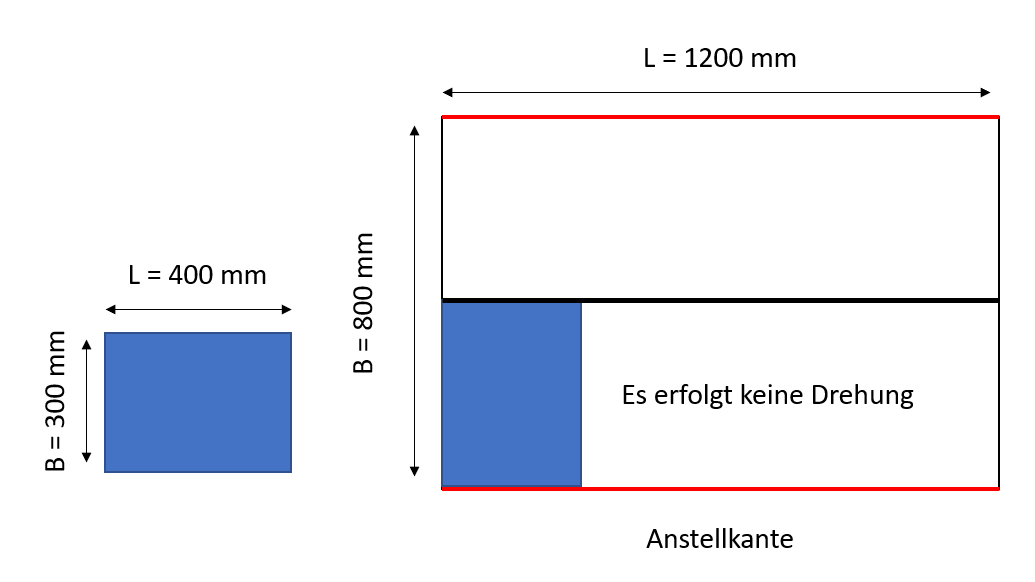
Case 3: Only one leading edge is selected for the material surface of the trailer.
If only one edge is selected for the material surface of the trailer, the placement follows the following logic:
The container is placed on the material surface in such a way that it occupies the smallest part of the leading edge in order to be able to place as many containers as possible next to each other.
Example case 3:
If only one leading edge is selected, the short edge is placed at the leading edge (except in the case that the long edge is greater than the distance between the leading edge and the opposite trailder side). This case will be repeated until this attachment edge is completely occupied.
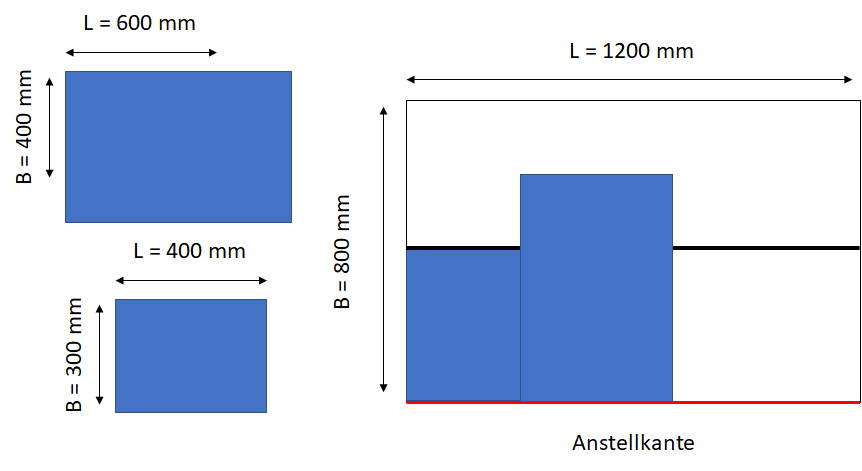
Further specifications:
- The same material is stacked on top of each other, if the height of the material area allows it.
- Full and empty containers of the same material are placed separately / not stacked on top of each other
- If an order does not fit collectively onto a trailer due to its reorder quantity, this order cannot be fulfilled
- The weight of the placed containers is taken into account and cannot exceed the maximum loading weight of the trailer used.