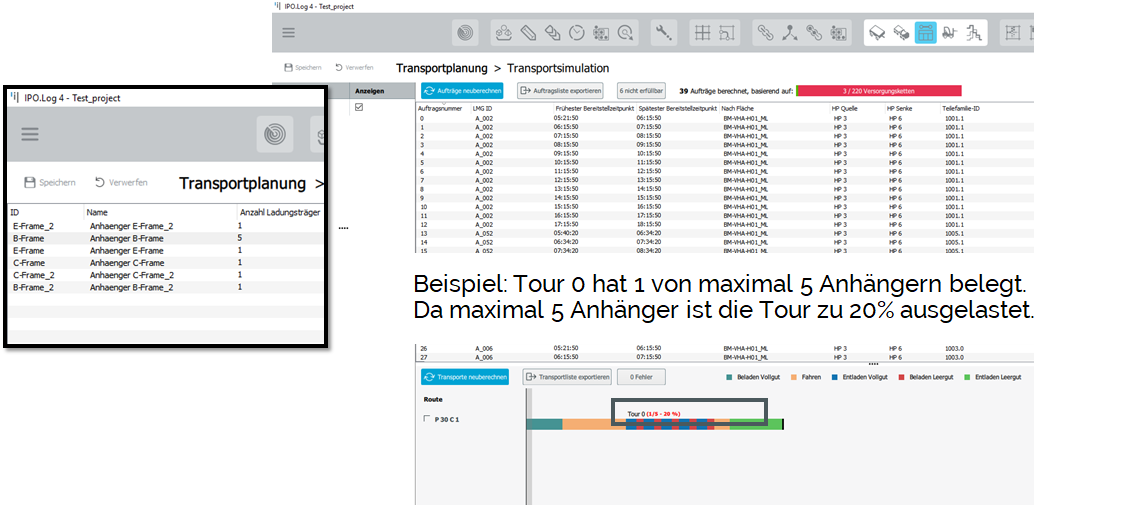

In ipolog 4 Material Flow, the maximum number of containers can be defined per trailer. In the following, the influence of the trailer capacity on the route planning of the routes is explained.
Chaining factor:
- The route planning algorithm considers the maximum number of trailers per tractor type.
- The specification comes from the resource management and can be found under the Tractor tab as an attribute in the right view.
LT per trailer
- The specification comes from the Trailer Assignment submodule from the right view.
- The planner specifies an average number of load carriers per assigned trailer type that can be loaded on the trailer as a maximum.
Procedure:
- The goal is always to maximize the capacity of a tour.
- A transfer order corresponds to one or more load carriers (depending on the replenishment quantity) containing the required material and thus taking up space on the trailer.
- If the maximum number of load carriers per trailer type is reached, a trailer is attached to the tractor
- If the maximum number of trailers on a tractor is reached on one tour, a new tour is generated on the same route and with the same tractor.
Influence of trailer capacity
Example of trailer capacity 1 (default value)
For example, if five orders are transported by the route in the same period (with the capacity of 1 container per trailer), the route train will use five trailers at the same time.
If you want to consider different number of load carriers for different types, you can create e.g. several trailer types.
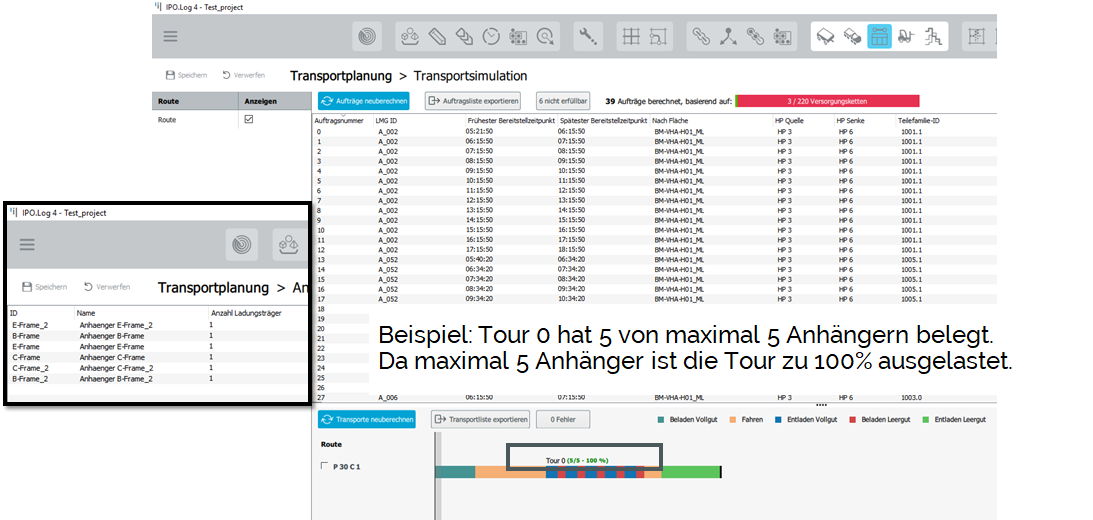
Example trailer capacity 5 (default value)
For example, if five orders are transported by the route in the same period (with the capacity of 5 containers per trailer), the route train uses only one trailer.