

The definition of the cycle time of a tugger train takes place in the submodule "Create routes".
Here you have to decide for each route whether it has a fixed cycle or not.
As soon as the checkbox for a fixed cycle is activated, the cycle time and the maximum tour duration can be defined.
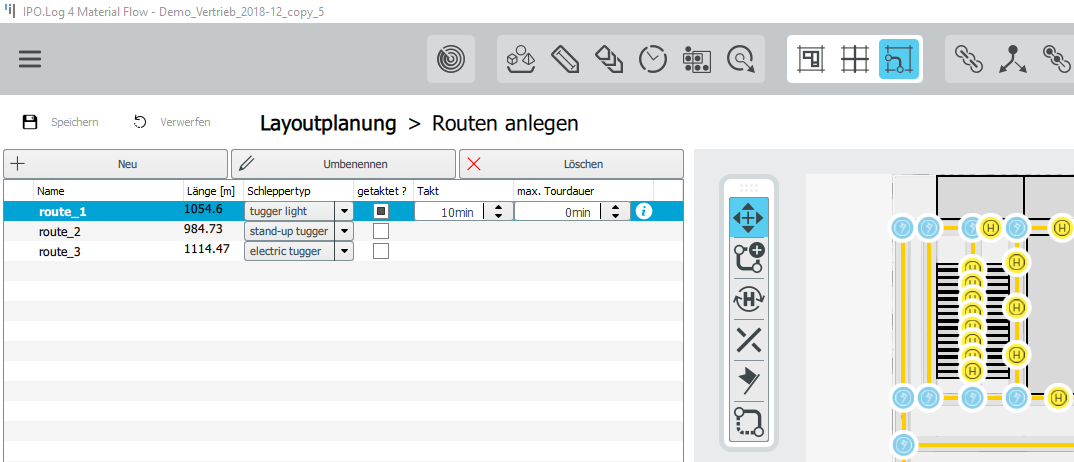
Cycle Time
The cycle time is set to 10 minutes by default.
The cycle time here means that from the beginning of the working time only one start of a tour at the time "Start working period + n* cycle time" is possible.
e.g. start working time 8:00 --> cycle start for the route train possible for 8:00, 8:10, 8:20, 8:30, 8:40, ...
If for example the work period 1 starts at 8:00 (as described above) and the work period 2 starts after a break time at 9:15, the first cycle of work period 2 starts at 9:15. The next following at a takt time of 10 minutes at 9:25, 9:35, 9:45, ...
Of course only values > 0 are possible.
Maximum tour duration
The maximum tour duration is 0 minutes by default. This means that there is no maximum tour duration. However, it can be changed for each route.
The maximum tour duration is the maximum time that a combination of different transport orders can take.
Therefore, tours in the transport simulation are never longer than the maximum tour duration entered. This is also taken into account when using the simualtion tolerance in the simulation parameters.
The effects of the defined cycle time and the defined maximum tour duration can be found, for example, in Transport Gantt in the Transport Simulation submodule.
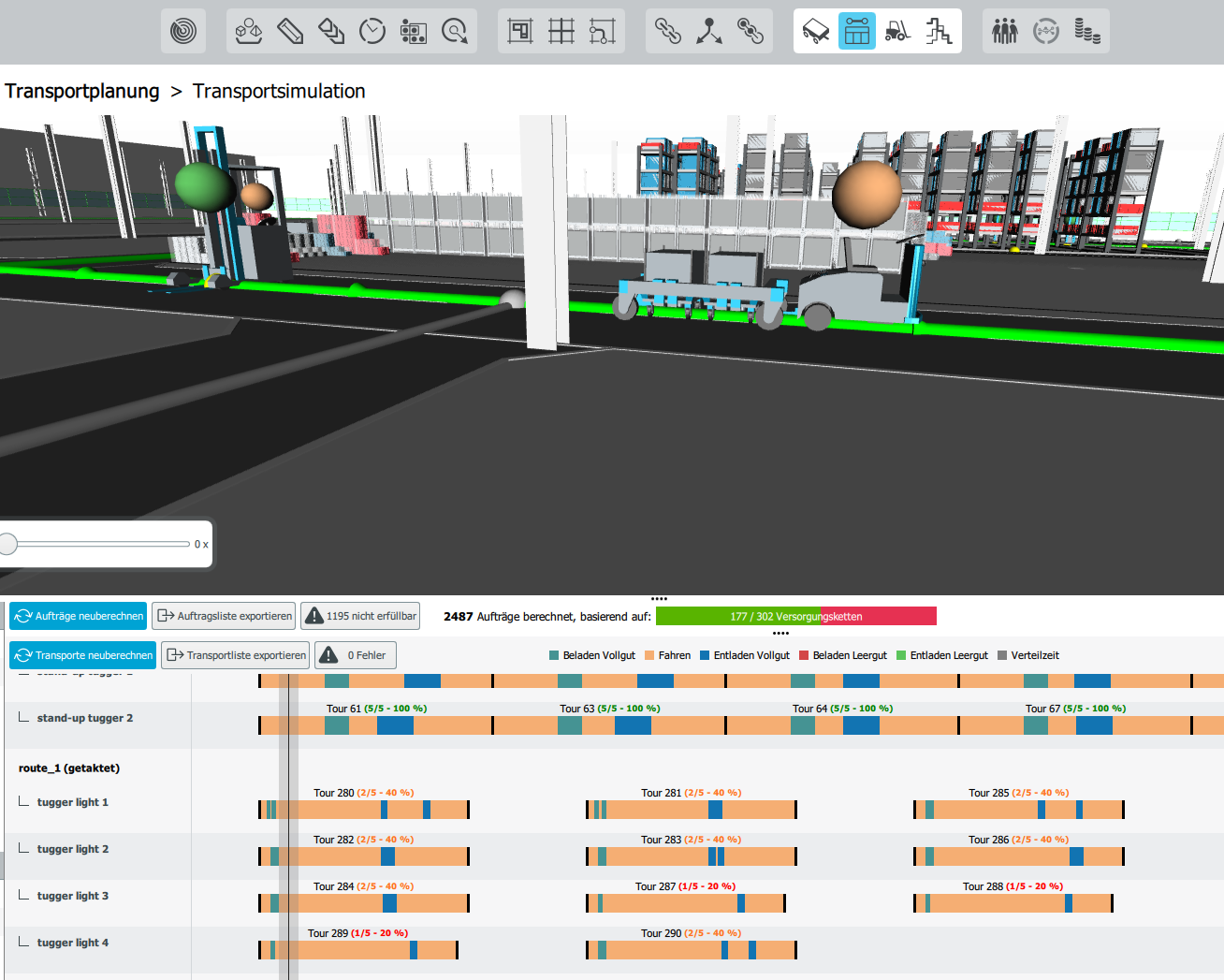
There are two reasons why transport requests cannot be fulfilled:
- No suitable cycle available:
The order cannot be completed within the cycle without waiting times, although it can be completed according to the shift schedule. - Duration exceeds maximum tour duration:
The maximum tour duration is less than the process times for an order plus the net driving time.