

In addition to importing provisioning requirements into the software, these can also be generated dummy-wise in the software.
The procedure for this is described in the corresponding article.
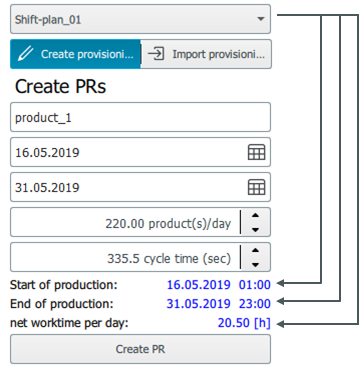
Based on the shift plan, the start of production and the end of production are used for the period of the calculation of material provision requirements.
The total net working time per day is also calculated on the basis of the shift schedule. This is calculated by subtracting the break times within the shift plan.
If the number of products per day is entered in the corresponding field, the takt time is calculated on the basis of the total net working time. The formula for this is:
Total net working time / products per day
However, if the cycle time is defined first and the products are to be calculated per day by the software, this is calculated as follows:
Products per day = total net working time / cycle time
These figures are decisive for the calculation of the consumption times:
- The first consumption of material from the logistics quantity structure takes place at the time of production start, provided that the assembly rate is 100%.
If the assembly rate is less than 100%, it is added together until 100% is reached/exceeded and only then is consumption generated.
Detailed Calculation: Within a product group, the production orders are distributed equally according to their assembly rates, so that the number of products per day (with assembly rate included) corresponds to the number of production orders.
Example: - 200 products per day within the product group
- Consumption rate for variant 1 within this product group is 50%.
- 100 production orders are generated - on average, there is one order for variant 1 every second cycle.
group. Further information about the Detailed Calculation can be found here. - The second consumption of material takes place in the same way after the cycle time has been added at the start of production, depending on the assembly rate. With this logic only integer consumptions are generated.
- This logic is decisive for the calculation of all consumptions. The parts are therefore always consumed at the beginning of the cycle.
- Before a break, the system does not check whether the cycle can be completed when generating provision requests.
- The remaining cycle time, which goes into the break, is continued after the break.
- Example:
- Cycle Time: 10 min
- Start cycle 1: 9:00
- End cycle 1 / start cycle 2: 9:10
- Accorduíng to the shift plan there`s a break between 9:15 and 9:30
- End cycle 2 / start cycle 3: 9:35
The following information from the logistics quantity framework is used for each consumption generated:
- LOG-ID
- Load Carrier ID
- Material Area
- Parts per product (for detailed calculation: Custom parts per Product group)
- Assembly rate (for detailed calculation: Custom assembly rate Product group)
- Supplier rate
This information is displayed accordingly in the table on the right side of the window.
| Column header | Meaning |
| Consumption time | Time at which the consumption occurs |
| Order Number | Automatically incremented by the software |
| LQF-ID | From the logisticy quantity framework |
| Loading-Carrier-ID | From the logisticy quantity framework |
| Area Name | From the logisticy quantity framework |
| Consumption Amount | consumption quantity at the displayed time |
| Product Name | For Base calculation: Base Product For Detailed calculation: name of the product group for which consumption is incurred |